Non Syndromic Form of Bilateral Bimaxillary Bull Teeth- A Case Report with Challenges in Pediatric Dentistry
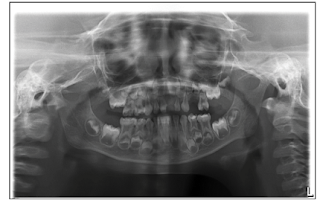
Genetic and Rare Diseases Information Centre (GARD),National Institutes of Health (NIH) and Orphanet, Europeanrare diseases database considers enlarged pulp chambers withroot dilacerations in primary teeth as a rare disease.Witkop defined bull teeth or taurodontism as teeth with largepulpchamber s in which the bifurcation or trifurcation aredisplaced apically and hence the chamber has greater apicooclusalheight than normal teeth and lacks cervical constrictionat CEJ. Bull teeth was first described in 1908 by Gorjanovic-Kramberger in a 70,000 year old pre-Neanderthal fossil,discovered in Kaprina, Croatia. Bull teeth were a frequentfinding in early humans and is most common today in Eskimos,possibly as a selective adaptation for cutting hide. The term‘taurodontism’ was however first stated by Sir Arthur Keithin 1913. The origin of this term is from Greek “tauros” whichmeans “Bull” and “adontos” which means “Tooth”. Theorigin of the word taurodont is from a combination of Latin and Gr...